
Demystifying Common Climate Science Terms: Hazard vs Risk
Every year, women in Gunungkidul, Indonesia watch the dry season arrive. The drought is predictable. But whether it destroys a family’s harvest, forces them into debt, or simply means a difficult few months – that depends on something else entirely.
You’ve probably heard both “hazard” and “risk” used in climate conversations. But they don’t mean the same thing, and understanding the difference changes how we think about our communities and our power.
- A hazard is the dangerous event itself. A flood. A drought. A heatwave. They are things that happen in nature, often made more frequent and more severe by a changing climate.
- Risk is how much that hazard can actually hurt us. And this depends on our situation, not just the hazard.
As part of the Community Resilience Partnership Program (CRPP)*, Huairou members from Yakkum Emergency Unit (YEU) in Indonesia and Lumanti Support Group for Shelter (Lumanti) in Nepal conducted climate risk mapping and vulnerability assessments in their communities. This is what their findings were, on hazards and risks:
- In Gunungkidul District of Indonesia, women farmers experience drought almost every single year. Drought is the hazard. But what turns that drought into a crisis is everything underneath it: the limestone terrain that holds almost no surface water, the pipes and reservoirs that crack and leak in the heat, the fact that families must buy water from trucks (paying between IDR 130,000 and 150,000 per tank) when their crops have already failed and their savings are gone. That is the risk. It is built from geography, poverty, infrastructure, and inequality, not from rainfall alone.
- The same pattern plays out in Kalaiya, located in the Bara District of Madhesh Province, Nepal, where Lumanti works with over 1,300 women in the Terai region. The hazard there is irregular rainfall, intense heat, and flash floods. But most farming families in Kalaiya are sharecroppers i.e. they work on land they do not own, without formal agreements, and are routinely excluded from government agriculture subsidies. When drought reduces their harvest, they must still hand over a share to the landowner, then take high-interest loans to survive. The hazard is the drought. The risk is shaped by land tenure, debt, and who has access to support.
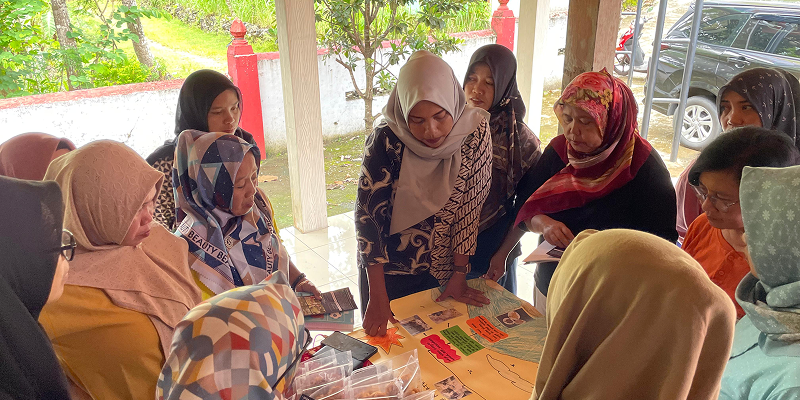
YEU members conducting Risk & Vulnerability Mapping in their communities
How They Connect
Think of two villages facing the same flood. One has strong riverbanks, early warning systems, and community savings. The other does not. The hazard is the same, but the risk is very differen
Experts describe it like this: risk is the combination of a hazard, plus how vulnerable we are, plus how little capacity we have to cope and recover.
In other words: the same hazard does not create the same harm for everyone. Who suffers most, and how much, depends on the conditions people already live in.
| Gunungkidul, Indonesia (YEU) Hazard: Drought, almost every year. What shapes the risk: Limestone terrain that holds almost no surface water. Pipes and reservoirs that crack in the heat. Families already in debt who must buy water from trucks at IDR 130,000–150,000 per tank when their crops have failed. | Kalaiya, Nepal (Lumanti) Hazard: Irregular rainfall, intense heat, and flash floods. What shapes the risk: Most farming families are sharecroppers with no land title and no access to government subsidies. When drought reduces the harvest, they must still hand a share to the landowner – and take out high-interest loans to survive. |
So what does this mean for us?
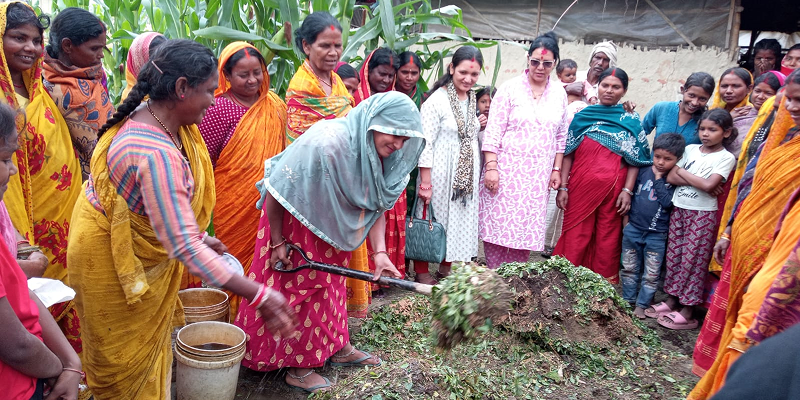
Grassroots women in Nepal implementing locally led adaptation practices to address climate change impacts
Climate change is making hazards worse around the world – more intense droughts, more unpredictable rains, more extreme heat. Yet the communities facing the greatest risks are largely those in the Global South, who have contributed the least to the emissions driving this crisis. This is the result of historic inequalities in wealth, land, and power that have never been fully addressed. And this is the foundation of any serious argument for climate finance, investment, and policy that actually reaches those who need it most.
This also means that our communities are not equally at risk just because we live in the same region. Risk is shaped by things like: who has access to water, land, savings, and information. Who is listened to in an emergency. Whether women, elders, and young people have a say in decisions. By how much support a government provides. These are not fixed, and they can be changed. That is where community action and local leadership matter most.
As Triyanita, a grassroots women leader from Mertelu village in Indonesia said, after leading her own community’s risk mapping process: “Women are among the most affected by drought because so many of our daily activities rely on water – and yet women are also the ones finding solutions, from growing vegetables in home gardens to coordinating water sharing across neighbourhoods.”
Understanding the difference between hazard and risk means understanding that communities like Triyanita’s are not passive victims of climate change. They are already acting. What they need is for governments, investors, and global institutions to act too – with resources, recognition, and policies that match the scale of the impact.
*The Community Resilience Partnership Program, co-developed by the Huairou Commission (Huairou), the Asian Development Bank (ADB) and other partners, works to scale up community-led climate action across the Asia-Pacific, with a focus on poverty, gender, and resilience.
This post was drafted with the assistance of AI writing tools. All content, perspectives, and organizational information originate from the Huairou Commission and its members. It has been reviewed and approved by our team.