
When the Cattle Leave: How Rural Women in Kenya Are Building Climate Resilience
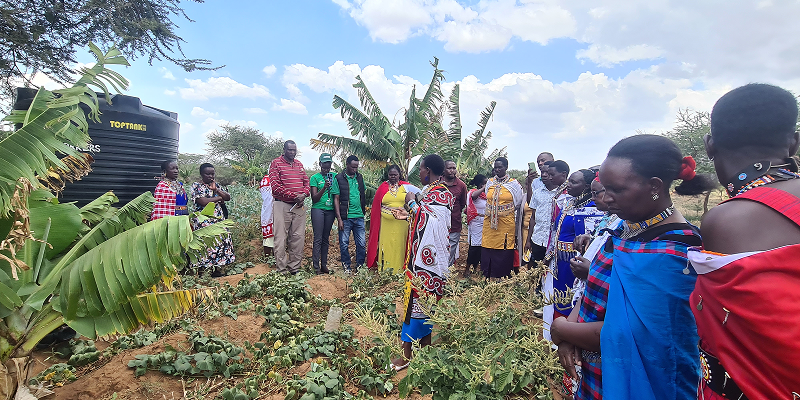
Kajiado County, a semi-arid region of Kenya, is home to the semi-nomadic and pastoralist Maasai community. As climate change intensifies and rainfall becomes increasingly unpredictable, Maasai pastoralist men are migrating further and for longer in search of pasture and water for their livestock. What once lasted a few months can now stretch to over a year, sometimes crossing national borders. The women stay behind.
Left to care for children and manage households – often without reliable food, income, or the milk and manure that livestock provide – these women face some of the sharpest edges of the climate crisis. Nearly half the population of Kajiado lives below the poverty line. Access to piped water reaches only about a third of households.
This is the reality that the Rural Women Network (RWN), a member of the Huairou Commission, has been working within for years.
Learning by doing – and then doing it at home
RWN’s response centers on five Livelihood Learning Centres (LLCs) spread across Kajiado County, in Ewaso, Keekonyokie, Iloodokilani, Kaputei, and Matapato. At these unconventional training facilities, women come to prepare land, plant, irrigate, harvest, and handle produce – learning through practice rather than instruction alone.
The crops are chosen keeping the local climate and community needs in mind: drought-tolerant cereals like millet and sorghum, nitrogen-fixing legumes that improve soil as they grow, and African Leafy Vegetables (ALVs) like amaranth and cowpea leaves that can be harvested repeatedly and are rich in nutrients. Fruit trees like mangoes, pawpaws, guavas are integrated into the farming system, improving soil conditions and providing food and income over the long term.
But it’s one innovation, in particular, that captures what RWN’s approach is really about.
A Spiral Gardens
Spiral gardens are a practical and transformative innovation introduced through the Livelihood Learning Centres in Kajiado County, designed specifically for areas with limited land and water. A spiral garden is exactly what it sounds like: a raised, coiled structure built from locally available stones, soil, and organic matter. Its layered design creates multiple planting levels with different moisture conditions, allowing a single compact garden to support 120 plants – enough to feed a family of five. Water applied at the top filters gradually down through the structure. Compost and manure reduce how often irrigation is needed.
These gardens are simple to build, low-cost, and maintained close to the homestead – accessible for daily care and harvesting. For women managing households alone in an arid region, that proximity matters enormously. And they work: women trained at the LLCs have gone on to replicate spiral gardens on their own farms, producing steady supplies of vegetables for household nutrition and surplus for sale.
Knowledge that multiplies
More than 5,000 women have been directly trained or have visited the Livelihood Learning Centres. The majority have applied what they learned on their own land – establishing kitchen gardens, adopting water harvesting techniques, and shifting toward crops better suited to Kajiado’s conditions. Many have become informal trainers themselves, sharing knowledge with neighbors and other women’s groups through RWN’s Training of Trainers model.
The result is a learning network that grows from within communities rather than depending on outside support to sustain it. Women who once had no reliable food source through the dry season now have kitchen gardens producing year-round. Those who sold surplus at informal markets are building toward more stable, market-oriented enterprises.
Resilience as a local project
What RWN has built in Kajiado is a demonstration that climate adaptation works best when it’s designed by and for the people most affected. The solutions here – spiral gardens, drought-tolerant crops, community seed sharing, women-led cooperatives – are centered around local knowledge, local conditions, and local leadership.
For the Huairou Commission, RWN’s work in Kajiado is an example of what locally led adaptation looks like in practice: women identifying what their communities need, testing what works, and sharing it outward. In a region where the effects of climate change are already reshaping daily life, that kind of grassroots-driven resilience is essential.
This post was drafted with the assistance of AI writing tools. All content, perspectives, and organizational information originate from the Huairou Commission and its members. It has been reviewed and approved by our team.